I finally finished my edits for my wip For the Next Killer Who Dies (FTNKWD). I managed to cut about 5K so now it’s only 130,000 words long.
While I wait for beta reader feedback, I wanted to rant about this wip even if this doesn’t make sense to 95% of the people in the world. I love this stupid book and I love my stupid, queer anthro crocs and you’re going to hear all about them because they’re amazing!
FTNKWD is about a group of queer anthro crocs giving middle fingers to colonial asshats. It’s basically Les Miserables meets Peaky Blinders meets Mindhunters
Basic summary:
Only defeated rebels get tried for war crimes. That’s why Kingsley, an anthro crocodile, is facing the empire’s noose. To save his life, he’ll have to lie through his teeth and manipulate Alex, a traumatized journalist whose wife Kingsley tortured. What? He’s done worse.
My favorite version of the summary:
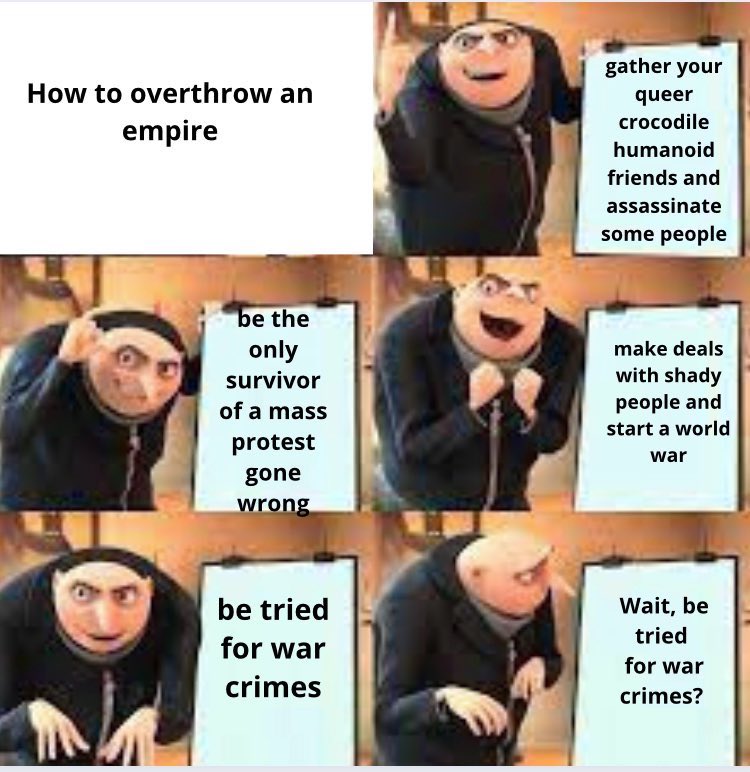
How to overthrow an empire
🐊gather your queer anthro crocodile friends & assassinate people
🐊be the sole survivor of a mass protest gone wrong
🐊make deals w/ shady people & start a world war
🐊be tried for war crimes
Wait, be tried for war crimes?
Story Origins
I took a look at my notes and I started this book in 2014! It was supposed to be a short companion novella for my trilogy (which is now a projected twelve book series). The novella version consisted of the first quarter (most of which hasn’t changed much structurally) and I added the rest after a beta reader said the novella ended abruptly and needed a better resolution. 130K words later…
The novella was supposed to be a brief glimpse into why Kingsley is the way he is but morphed into a deeper study of Kingsley, his friends and comrades, and the empire oppressing him, while hinting at the great upheaval that’s affecting the continent as a whole.
Back in the day, the series was organized in a very X-men way where you had a group of people fighting for a world that despised them and several groups of people who just wanted to watch the world burn and so this was supposed to be Kingsley’s five-issue run where we learn why he, specifically, struck the match that lit the world on fire.
While the conflict and Kingsley’s motive is a bit more nuanced now, the point of the wip is still the same. The world Kingsley lives in sucks and this is why he decided to destroy all of it except this small corner he’s claimed for himself.
The structure of the book is still similar to the original novella in the sense that the first quarter hasn’t really changed structurally from the first draft, but everything after chapter sixteen has been rewritten, reshaped, and reformed a million times.
I think it’s because the first quarter is myopic and focused only on Kingsley and his small corner of the world whereas the second part opens the story to encompass several of his neighboring states and it’s a challenge to provide enough info so the reader can learn about the bigger picture, understand where Kingsley fits in the bigger plot, and lay seeds for the next few books while also stressing that the bigger world is in so much trouble and misery and that it doesn’t care about Kingsley’s plight which pushes him towards setting the world on fire.
Rewriting Hell
I’ve rewritten FTNKWD at least twenty times between 2015 and today. Two of the biggest developments that came out of the many rewrites was the introduction of Alex’s storyline and the entire second half.
Alex, the traumatized journalist Kingsley has to manipulate, wasn’t in the original draft at all. It was just going to be a memoir written by Kingsley, but the more I thought about the project, the more I liked the idea of making Kingsley an unreliable narrator with Alex as our trusted source of truth who could challenge his lies. But then Alex developed over the years and I realized that even he couldn’t be trusted because, when dealing with historical records and memory, no one is without bias.
while Kingsley’s memoir is the main storyline, there is this extra storyline where older Alex and Kingsley fight for control over the very narrative the reader was reading…because why make things simple? I’m not sure if I’ll continue Alex’s storyline into the other books or if it’s a one time thing because it makes everything so complicated, but it’s also a lot of fun, so we’ll see.
Like I said above, the second half exists to complete Kingsley’s corruption arc and connect his story to the grander narrative that propels the series as a whole. It’s probably my favorite part of the book, but it’s also caused me the most headache because SOOOOO much happens and trying to make sure everything and everyone gets their due without blowing up my word count has been a challenge to say the least.
This latest rewrite nearly killed me though because I was five chapters away from completing the rewrite when my external hard drive that contained everything died and I didn’t have any other backups of FTNKWD before 2020. So I waited for a month, on the verge of depression and suicide, waiting for Best Buy to confirm they rescued FTNKWD from the abyss.
First, they “lost” the harddrive, but nope turns out it was just never scanned but it made it to the recovery place just find, then it would take four weeks to recover everything (as opposed to the two weeks they originally told me) and then nope (while I’m literally getting on a plane to DC) I get a call from Best Buy telling me all my data has been recovered and they’re sending it back to the office in Chicago.
Why I Love my Queer Crocodiles
Les Miserables
When the idea for FTNKWD popped into my mind, my original inspiration was Les Miserables, one of my all time favorite musicals and books. There was a point in my life when I literally had the entire soundtrack on repeat for the entire day for weeks at a time. It’s probably the only reason my parents bought me a portable CD player (because my mom also loves the musical but apparently wasn’t willing to listen to One Day More eight times a day. I can’t imagine why). I also re-read the book almost every year around Christmas time and can pull passages from the book from memory at any given time. So to say that Les Miserables is an influence is a bit of an understatement.
But Les Miserables is a huge book and play, so which parts specifically inspired me? Obviously the ABC friends and the barricades as I do have a barricade scene in the book, but even more specifically I was intrigued by the idea of Enjolras being beautiful and terrible. While I was obsessing over Les Miserables, I was also dipping my toes into what would become my academic obsession: asymmetrical warfare, particularly the IRA. My mind made this odd connection between Enjolras leading his friends to die and Patrick Pearse’s willingness to die at Easter Rising and this question arose in my mind: what sort of man can look their friend’s in the eye and ask them to die for nothing more than an intangible dream? This, Siegfried, Kingsley’s cousin and one of his biggest influences was born. I took Victor Hugo’s romantic glorification of Enjolras and the barricade as Kingsley’s voice but allowed Alex to interject this equally real and valid criticism about the pitfalls of martyrdom and the horrors of Enjolras’ and Siegfried’s terrible beauty.
I also found great inspiration in the criminal underworld of Les Miserables (and Hugo’s defense about why he’ll always use the Argot language in his work, thank you very much) and so you have the bank robber, the sex worker, the drunken brawler, all these “undesirable’ elements of society that mean more to Kingsley than the entire world while also exploring that fine line between crime and “freedom fighting”. And the hypocrisy of criminalizing the poor and then getting angry or upset when they fight back.
I also took Thenadier as he appears in Beggars at the Feast and turned him into an ‘undesirable’ politician who will do whatever is necessary to stay on top and “when the richest grease us, we’ll see you all in hell.” Basically, Thenadier’s evil because his own incompetence leads him to exploit others (such as in Dog Eats Dog) but at the same time he never quite makes it, does he? He’s always falling short of his grandiose expectations and for various reasons will never make it, trapped in his squalor and bitterness and determined to prey on others. And so I took that, but transported him to the upper class, which in my mind makes him even more dangerous.
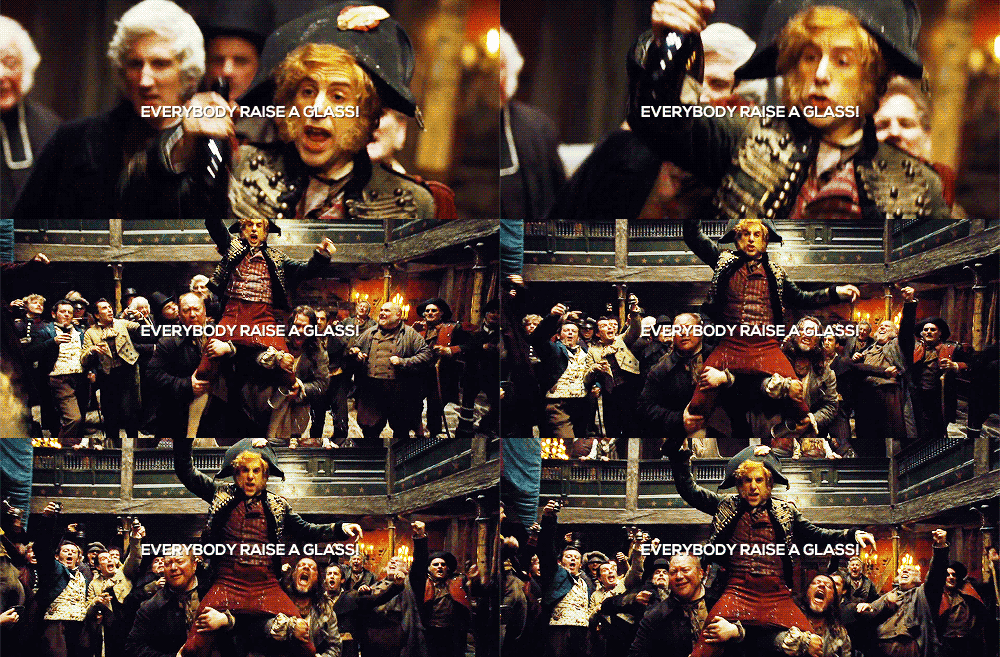
And Javert sort of got torn into two different characters: the terminator like Griffin who will uphold the law no matter the cost and Dara, the good “human” character who increasingly realizes that to be a good person and uphold the law is an impossibility but never quite making the connection that the law is wrong.
And of course I have a sewer scene because am I really a Victor Hugo fan if I don’t have at least one sewer scene?
I just really love Les Miserables, ok guys? It just needed queer anthro crocodiles, clearly.
What Would the IRA Do?
If you’ve read my blog www.samswarroom.com or listen to my podcast Art of Asymmetrical Warfare, you’ll know that I am academically obsessed with the IRA and so it’s probably no surprise that worked its way into this book (but is a little weird I’ll admit).
It wasn’t like I thought you know what animal I associate with the IRA, crocodiles.
It was more like I got angry crocodile people who want to rebel but neither of us know how to rebel so we need advice from experts and then I bought a bunch of books about the IRA.
Interestingly, if the first half is basically Les Miserables rewritten with crocodile people, the second half pulls a lot from my research. Some of the references are superficial-like giving the human president a big red map he can use to intimidate Kingsley like Lloyd George tried to intimidate Dev, some characters sharing last names with famous rebels, etc and Kingsley utilizies bombing campaigns, assassinations, and guerilla attacks. I couldn’t work in a full cleansing of the human intelligence ring, but there are references of an intelligence war as well as prison strikes and rebels.
But one of the core struggles in the second half is how do you recover from something like the barricades or Easter Rising, how do you build state capacity while supporting a country-wide insurgency with limited means, how do you manage large personalities who despise each other, and how do you define victory and what happens when a violent minority rejects your victory. And there’s the added layer of “preserving” the rebellion and the fight over public memory. Which atrocities do you memorialize and which ones do you forget and what happens when it’s your own leaders who committed the atrocity against your own people?
And, the latest development, is the growth of trade unionism espoused by Larkin and Connolly. There’s a huge union thread that I recently added with this latest rewrite which sort of connects to the question of state-building, but also bleeds into this question of what do you do when the empire “grants” you access to powers and positions they’ve traditionally held only for themselves? Can you rewrite a state from the inside? Like when should you strike unarmed and when do you go on strike side by side with a citizen army to protect you from the state?
Understanding “Evil”
I love shows like Hannibal and Mindhunters. One of the reasons is because there’s something fascinating about evil trying to explain itself. I couldn’t tell you why I enjoy this in fiction so much. I think I’m just a goth who loves to indulge in the dark and twisted, but when I introduced Alex I realized I could do my own twist on “understanding evil”, where the word “evil” does a lot of heavy lifting because Kingsley is a freedom fighter first and foremost (he’s also a dramatic asshole who probably deserved some of what happened to him).
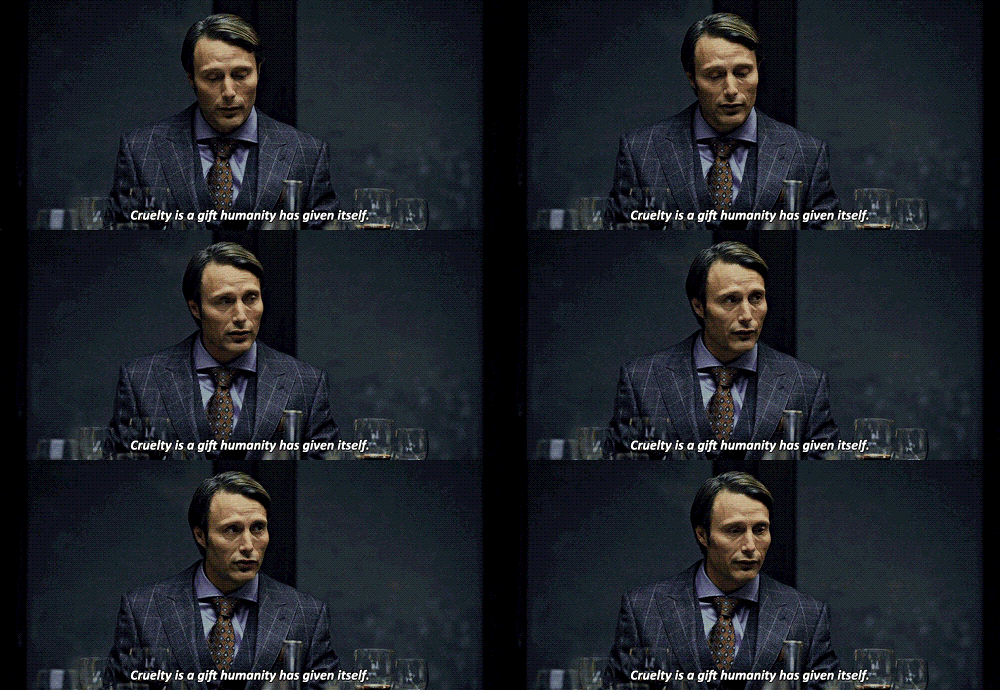
When I first introduced Alex, it was meant to highlight when Kingsley was lying-and he does that-but it’s also to highlight how the society Kingsley lived in handed him the book of matches he used to burn down the world. This is the only part I’m still trying to perfect (I hope my beta readers have a few suggestions) but I want it to be perfectly f*cking clear that while Kingsley did these terrible things, he’s not the villain. He’s just the sacrificial lamb whose blood will be used to spare the real villains. And thus Kingsley’s story becomes a confession for those who would never confess and then Alex has to decide what to do with this truth he unexpectedly uncovered.
Fucking Peaky Blinders
I love gangster films and shows. I love Guy Ritchie movies. I love it every time a criminal gives a big middle finger to the law and Kingsley allows me to indulge in that chaotic, rough, unrefined violence and rule breaking Guy Ritchie and the show Peaky Blinders have perfected. I remember watching Peaky Blinders and being reality depressed for a good minute, thinking my god it’s my book but with humans!

And while my book takes a different direction than the show Peaky Blinders, there is a heavy criminal and violent element to my book, there is a seedy, undergroundness to the world Kingsley lives in, and one of the core arguments in both Peaky Blinders and FTNKWD is that a politician is just a legitimate gangster. The only thing I’m missing, honestly, is an Alfie Solomon, but maybe I can save him for my next book
Everyone is Queer!
I mean the section header says it all. Almost everyone in FTNKWD is queer and if they’re not queer on the page it’s just because we haven’t decided what kind of queer they are just yet, but will confirm their identity in later books.
In this book, I was able to create agender as well as aro-ace characters that are like me, which was really cathartic, and also helped me expand how my world feels about the LGBTQ+ community and where they are medically in terms of supporting transitioning, abortions, etc. And I basically decided they’re even further along than we are because a. They’re super supportive of the LGBTQ+ community and you’re ostracized and seen as danger if you’re not b. They have snake like people who can control their own genders at will and are creating pills and medical procedures based on their own experiences to help other races do the same, and c. there weren’t any Nazis to burn decades of trans and LGBTQ+ research.
Having queer characters in traditionally “heterosexual, masculine” roles was really interesting. In some ways I didn’t think about the fact that Kingsley is a gay crocodile person and Kerry, one of the most wanted and most dangerous rebels in the book, is aro-ace, nonbinary masc but then there’s Oisin, who I purposely wrote as a loud and proud gay, gender-nonconfirming crocodile who was also a sex worker (which is legalized and regulated in my world) AND the most powerful politician in the country, and maybe the fifth most powerful on the continent. Like he almost takes over the book during the third act, that’s how awesome and important he is.
The inspiration for Oisin’s relationship with his sexuality and power, oddly, enough came from the movie Darkest Hour. At the very end, Churchill’s wife is posing for war time propaganda pictures, you know the “we’re rich but we’re also making sacrifices to support the war effort” and I realized at the moment that Oisin would have to take the same photos since he’s Kingsley husband and I realized how powerful it was that Oisin would take those propaganda pictures and also pose for pinups and pilots would paint his pinup pictures on their planes. And suddenly his sexuality and his gender were tied to his power as a politician and I really wanted a character who was the “wrong gay” in every conservative way become this symbol within my world and hold so much power that he could reshape the continent if he wanted to.
Those are just some of the reasons why I love this book and I hope, some day, some other weirdo can read it and fall in love with my broken and angry queer anthro crocodiles. Until then, I’ll leave you with the last line from the book:
Let the dead rest, Alexander, for once risen, they will consume us all.
 Pepper Writes
One thought on “A Post about the Queer Anthro Crocodile book”